Hello peeps
It has been a busy couple of days. I have been travelling on my own since I left Delhi, but have been enjoying my own company. And a major advantage is one gets to chat more with the locals.
Delhi was a relief after the hardcore Leh-Delhi-Amritsar-Delhi run. I spent the day basking in the luxury of Jackie's company. She is working hard and has recently had her first front-page spread in the Wall Street Journal: so many congratulations to her. I also met one of her mates, a French radio journalist, who lived up to all my stereotypical expectations. He was short and lithe, his dark hair peppered with grey. And permanently fixed sunglasses, from which I was sure he was taking every movement in. He rarely smiled and barked his opinions staccato-style. I floundered as they discussed Asian politics, ignorant of the names and developments. It sounded very exciting though: intrigue and chicanery, like dialogue from "All the President's Men" or something. It made corporate law seem very dull. Mind you, I suppose most professions make corporate law seem very dull. Except maybe, chartered accountancy (and even that is a close run).
I have touched on my visit to the Taj Mahal in my early blog. But I also visited the Agra Fort (which was kind of like the Red Fort in Delhi, except bigger); the little Taj (which was exceptionally pretty); the fort at Gwalior; and now Orchha (which is aflush with palaces and temples). In each place, Indians asked for my photo. This struck me as particularly odd: why on earth would anyone want a photo with me? In response, I used an old tactic that generally put them off, ie when receiving their request, to stick out my hand and demand 10 rupees. Only one chap reached into his wallet to give me the change, which made me laugh, so I allowed him to take my picture (for free, indeed).
At the beginning of my trip, I read the novel Shantaram (which I understand is set to be filmed in Bombay shortly, starring Johnny Depp, http://www.imdb.com/title/tt0429087/). In the book, (sorry Will and Jackie, but promise this is not a plot spoiler) there is the description of a road accident and the subsequent mob attack on the driver who caused the collision. On reading it, I had thought Roberts' was possibly exercising hyperbole. However, on my way to Orchha there was the burnt out skeleton of a lorry, slap-bang in the middle of the road, around which all the cars were cagily navigating. It struck me as odd that no one had moved it, and it appeared to be a very recent wreckage. But it was in the midde of the road. No other vehicle seemed to be involved... I asked the driver of my taxi what had happened. He explained that a couple of days ago there had been a tragic accident, in which a lorry had run down a local child. In response, the people had set on the driver and his truck. And those were the remnants.
Orchha is very pleasant. The place is abound with historic palaces, temples and cenotaphs, and the Betwa River lazily winds its way through the town. This morning I went for a long, hot walk around the sites, enjoying the tranquility of the place. For instance, when I visited the chhatris, I had to wake up the attendant so he could unlock the cast iron gates, and I was ushered into a lush elaborate graveyard to ramble through the verdant undergrowth. I could smell the sweet, rich scent of decaying vegetation. On my way back into town, I stopped to browse in a small shop. The owner looked straight into my eyes and asked me to join him for some chai, to which I agreed. He was in his mid sixties, with white hair and white beard. A filthy white vest stretched over his stomach. But he had nice brown eyes. We started chatting. The usual: where are you from, what do you do, are you married. He was clearly a prosperous man (he'd worked for gold mine companies, being stationed around India, before retiring to open his shop in Orchha). He talked a little about his children. And then he started talking about his wife. He had lost her only eight months previously; she'd died at 48 after an illness. And he missed her. Every day he missed her. But there was nothing he could do to stop thinking about her and the fact she wasn't there. He wrung his hands and asked me to stay for a second tea. Then he showed me a picture of his wife. He was suffering terribly. He explained that he did not have the will to shave or change clothes. I think he saw a little bit of her in me. I stayed as long as I could (three cups of tea). He gave me a present of beads when I left. But I felt terrible that I couldn't really do anything to relieve his pain. What can you do when someone is that lost?
On that note, I shall shoot.
Ciao
Monday, 27 August 2007

Sunday, 26 August 2007
Taj Majal
I just visited the Taj Mahal as the sun came up. It was beautiful: a truly magnificent monument. I feel extremely spoilt to have seen such amazing pieces of architecture in a matter of days.
Something you don't really appreciate from the pictures is how tranquil it is. You enter the area through a red sandstone building, and are met with a glimpse of the white Taj through an archway. But preceding it, is a length of water and greenery: neatly trimmed lawns and symmetrical lines of trees.
Super.
I have changed my mind: I am going to go to Gwalior and Orchha now. And then Khajuraho, by which point, I shall be monumented out. I think.
http://en.wikipedia.org/wiki/Gwalior_Fort
http://en.wikipedia.org/wiki/Orchha
http://en.wikipedia.org/wiki/Khajuraho
Something you don't really appreciate from the pictures is how tranquil it is. You enter the area through a red sandstone building, and are met with a glimpse of the white Taj through an archway. But preceding it, is a length of water and greenery: neatly trimmed lawns and symmetrical lines of trees.
Super.
I have changed my mind: I am going to go to Gwalior and Orchha now. And then Khajuraho, by which point, I shall be monumented out. I think.
http://en.wikipedia.org/wiki/Gwalior_Fort
http://en.wikipedia.org/wiki/Orchha
http://en.wikipedia.org/wiki/Khajuraho
Saturday, 25 August 2007
Amritsar and other stories
Dear all
Goodness, it was a fleeting visit to Amritsar, for sure. But I managed to pack a lot in.
I arrived very early, around 6.30am, and the town was quiet. I found my way to the Golden Temple, an amazing Sikh monument crafted from white marble, crowned by a golden dome in the shape of a lotus leaf, floating on a tranquil lake. Of course, I was lugging my rucksack, and wasn't sure what the formalities were (where to leave my shoes, where to wash my feet, when to adorn my scarf (ie my beach sarong)).
Euch. There is cockroach roaming the keyboard while I am typing.
Anyway, I eventually found the Sri Guru Ram Das Niwas. This is a large complex for the pilgrims, which provides rooms, toilets, communal showers and a 24-hour restaurant to feed the masses, all for free. They have special dorms for the foreigners, which is where ... euch the cockroach is back again ... you can find a bed for the night. These are pretty basic. The one I was allocated was windowless, stuffy and grimy. And I don't think they change the sheets. But it was fine for me. Because I had taken the sleeper train the night before, I had slept in the clothes I was standing in. And evidently hadn't been able to wash either; therefore the state of the room made little difference to me. But it was great to put down my bag and sit down for a second.
There seemed to be a mound in the corner of the dark room from which the broadest Scouse accent I have ever heard emanated. It took me a second to tune in; as it did for him to tune into my nearly-received-pronunciation accent. And that is how I met Dave, a really nice chap from Liverpool. Dave spent the day educating me in -- what I would call -- conspiracy theories (I am sure he will put me right if that is a misdescription) and we had a couple of good chats; although everything I'd read in the Illuminatus trilogy escaped me. So I was probably a bit useless.
We decided to go off exploring. So -- still not having tried out the shower facilities -- we went off round the Temple. This included making a donation: I handed cash over; in return I was given a brown concoction in a cardboard bowl and a couple of dried leaves. I was unsure what I was supposed to be doing with the goo. But as ever in India, someone was on hand to point me in the right direction. So I took my brown stuff and queued, hoping I would be able to give it away. But they only seemed to want a half of it; leaving me with the rest. I hid it in my bag for a bit, until I could quietly deposit it from prying eyes. But it was to no avail: before leaving the Temple, some more was thrust upon me. And then I found out it was for eating. It was with some trepidation I put it in my mouth, more because my hands were slovenly filthy. But it was quite nice and I am still alive.
From there, it was a quick visit to the Sikh museum which is a gory collection of pictures. If anyone fancies some inspiration on martyrdom, this is the place to come: graphic depictions of decapitations, people being sawn in two, being tortured on a spiked wheel, and a rather unpleasant painting of slaughtered babes-in-arms being hung around the necks of their sobbing mothers. And a host of photos of those who had died: kind of before-and-after collages. All rather disturbing.
Our other stops included the Mata Temple. This was fun. It involved crawling through small tunnels and walking through ankle deep [far-from-fresh] water, bare foot, of course. I understand that women come here if they wish to become pregnant (but I advise you don't get your hopes up, mum).
We also visited the Jallianwala Bagh. This is a garden built to commemorate the massacre which took place there in 1919, when General Dyer ordered 150 troops to open fire on a peaceful demonstration. The gathering was taking place in an open space surrounded by high walls. There was carnage: within six minutes 337 men, 41 boys and one baby were killed, and 1,500 wounded. (The event is captured effectively in Attenborough's Gandhi.) What I found most disturbing was the well in the garden. A number of the protestors had sought refuge in it, throwing themselves in for cover. It is a wide well: a couple of metres in diameter. And it is a deep well: you can't see the bottom; it is a just black abyss. Meaning, it is large well: over 180 bodies were pulled from it after the shootings.
The final stop of the day was in Attari/Wagah to watch the bizarre border display in which the Indian and Pakistani border guards carry out a ceremony each evening, trying to outdo each other in pomp and circumstance. It was most peculiar. The spectators are all seated high above the roads leading to the gates, on purpose built grandstands. The crowds are expected to egg the guards on and we were encouraged to do lots of shouting, singing, and -- strangely -- to support individuals selected to sprint the length of the track in pairs to while waving Indian flags. The sight of plump ladies in saris, struggling to keep up a decent pace in their pink pumps, keeping a (rather worse for wear) Indian flag aloft, was decidedly surreal.
However, I was seated in the ladies' section and for the most part was preoccupied with taking photo after photo of the audience who -- judging from their excitement -- had never seen a digital camera before. It took a lot of persuasion to explain that I wouldn't be coming back to Amritsar in a hurry, and could I watch what was going on below, please. It means I have lots of pictures of the audience; if not the border display.
I returned to Delhi overnight on another sleeper (cattle class again, as there were no other classes available) and caught up with Jackie. I arrived on her doorstep absolutely filthy, not having showered for several days and my clothes black with grime. I think she was slightly shocked.
But more of this all later. I am very tired, not having slept in a bed for two nights, and covered goodness knows how many kilometres in the last three/four days.
I am now in Agra. I have caught sight of the Taj - a grey outline - from the roof terrace of my guest house. I intend getting up at 5am to see sunrise; I shall of course let you know how it goes.
Bises, mes puces.
Goodness, it was a fleeting visit to Amritsar, for sure. But I managed to pack a lot in.
I arrived very early, around 6.30am, and the town was quiet. I found my way to the Golden Temple, an amazing Sikh monument crafted from white marble, crowned by a golden dome in the shape of a lotus leaf, floating on a tranquil lake. Of course, I was lugging my rucksack, and wasn't sure what the formalities were (where to leave my shoes, where to wash my feet, when to adorn my scarf (ie my beach sarong)).
Euch. There is cockroach roaming the keyboard while I am typing.
Anyway, I eventually found the Sri Guru Ram Das Niwas. This is a large complex for the pilgrims, which provides rooms, toilets, communal showers and a 24-hour restaurant to feed the masses, all for free. They have special dorms for the foreigners, which is where ... euch the cockroach is back again ... you can find a bed for the night. These are pretty basic. The one I was allocated was windowless, stuffy and grimy. And I don't think they change the sheets. But it was fine for me. Because I had taken the sleeper train the night before, I had slept in the clothes I was standing in. And evidently hadn't been able to wash either; therefore the state of the room made little difference to me. But it was great to put down my bag and sit down for a second.
There seemed to be a mound in the corner of the dark room from which the broadest Scouse accent I have ever heard emanated. It took me a second to tune in; as it did for him to tune into my nearly-received-pronunciation accent. And that is how I met Dave, a really nice chap from Liverpool. Dave spent the day educating me in -- what I would call -- conspiracy theories (I am sure he will put me right if that is a misdescription) and we had a couple of good chats; although everything I'd read in the Illuminatus trilogy escaped me. So I was probably a bit useless.
We decided to go off exploring. So -- still not having tried out the shower facilities -- we went off round the Temple. This included making a donation: I handed cash over; in return I was given a brown concoction in a cardboard bowl and a couple of dried leaves. I was unsure what I was supposed to be doing with the goo. But as ever in India, someone was on hand to point me in the right direction. So I took my brown stuff and queued, hoping I would be able to give it away. But they only seemed to want a half of it; leaving me with the rest. I hid it in my bag for a bit, until I could quietly deposit it from prying eyes. But it was to no avail: before leaving the Temple, some more was thrust upon me. And then I found out it was for eating. It was with some trepidation I put it in my mouth, more because my hands were slovenly filthy. But it was quite nice and I am still alive.
From there, it was a quick visit to the Sikh museum which is a gory collection of pictures. If anyone fancies some inspiration on martyrdom, this is the place to come: graphic depictions of decapitations, people being sawn in two, being tortured on a spiked wheel, and a rather unpleasant painting of slaughtered babes-in-arms being hung around the necks of their sobbing mothers. And a host of photos of those who had died: kind of before-and-after collages. All rather disturbing.
Our other stops included the Mata Temple. This was fun. It involved crawling through small tunnels and walking through ankle deep [far-from-fresh] water, bare foot, of course. I understand that women come here if they wish to become pregnant (but I advise you don't get your hopes up, mum).
We also visited the Jallianwala Bagh. This is a garden built to commemorate the massacre which took place there in 1919, when General Dyer ordered 150 troops to open fire on a peaceful demonstration. The gathering was taking place in an open space surrounded by high walls. There was carnage: within six minutes 337 men, 41 boys and one baby were killed, and 1,500 wounded. (The event is captured effectively in Attenborough's Gandhi.) What I found most disturbing was the well in the garden. A number of the protestors had sought refuge in it, throwing themselves in for cover. It is a wide well: a couple of metres in diameter. And it is a deep well: you can't see the bottom; it is a just black abyss. Meaning, it is large well: over 180 bodies were pulled from it after the shootings.
The final stop of the day was in Attari/Wagah to watch the bizarre border display in which the Indian and Pakistani border guards carry out a ceremony each evening, trying to outdo each other in pomp and circumstance. It was most peculiar. The spectators are all seated high above the roads leading to the gates, on purpose built grandstands. The crowds are expected to egg the guards on and we were encouraged to do lots of shouting, singing, and -- strangely -- to support individuals selected to sprint the length of the track in pairs to while waving Indian flags. The sight of plump ladies in saris, struggling to keep up a decent pace in their pink pumps, keeping a (rather worse for wear) Indian flag aloft, was decidedly surreal.
However, I was seated in the ladies' section and for the most part was preoccupied with taking photo after photo of the audience who -- judging from their excitement -- had never seen a digital camera before. It took a lot of persuasion to explain that I wouldn't be coming back to Amritsar in a hurry, and could I watch what was going on below, please. It means I have lots of pictures of the audience; if not the border display.
I returned to Delhi overnight on another sleeper (cattle class again, as there were no other classes available) and caught up with Jackie. I arrived on her doorstep absolutely filthy, not having showered for several days and my clothes black with grime. I think she was slightly shocked.
But more of this all later. I am very tired, not having slept in a bed for two nights, and covered goodness knows how many kilometres in the last three/four days.
I am now in Agra. I have caught sight of the Taj - a grey outline - from the roof terrace of my guest house. I intend getting up at 5am to see sunrise; I shall of course let you know how it goes.
Bises, mes puces.
Friday, 24 August 2007
Post office and sleeper adventures
Sweethearts
I have had such an exciting time since I last wrote that I can barely contain myself...
After I finished my last blog I decided that I had to lose some of my accumulated gear and send it back to England. I debated how this ought to be done. I considered DHL, but at 3000 rupees per kilo (over 30 pounds per kilo) it was a little extravagent. The post office appeared a much better option.
In the UK, I suppose what I would do would be to appropriate a banker's box from a generous employer and pack my stuff up. Here in India, I wasn't sure what the deal was and I had no idea where to find a box (or three).
But seriously, how difficult can it be to send stuff home? People do it the whole time, right?
Possibly. But obviously not from Delhi post office.
The post office is situated on a large roundabout in New Delhi with nothing near it for miles. I lurched into the building, laden like a pack horse: wearing my rucksack, a daypack, and carrying three carrier bags and a second rucksack. It was with some disdain that the woman at the help desk eyed me up and down and flagged for me to sit down. I did so. And then patiently waited 45 minutes. At this point (bearing in mind I had a train to catch) I aproached the desk again and asked about the container packaging advertised in a poster on a wall. Promptly I was told they didn't have any boxes. Oh. Where could I get one, I asked. The man helpfully explained that I should go to Paharganj (about 4 km away) where I would find someone to sort it. But the post office could not help me. I smiled gratefully and wobbled off under my heavy load and outside I tried and tried to hail an auto rickshaw on my roundabout in the middle of no where in urban Delhi.
An autorickshaw pulled over and a very well heeled chap and his attractive lady companion hopped out. As is so often the case in India, people stop to enquire about your business. In this instance the couple -- on hearing that I was on my way to Paharganj to send things back to England -- looked at me in absolute horror. They could not believe that the post office was sending me on such a wild goose chase. On hearing my plight, the chap frog-marched me back into the building (giving the attractive young lady my bags to carry) and had it out with the chap at the post office counter.
Miraculously, within seconds, a packer had arrived. Quickly followed by some cardboard boxes. Soon everythings was neatly tidied away; the man then fitted white muslin around the box and sewed it all together. Unfortunately, my new-found friends were 20 minutes late for a business meeting and had to dash off. But by the time the package was ready, most of the post office had been involved in the debacle in one shape of form, so when I bid the room farewell, everyone turned and waved.
I now have 11kg winging its way to England.
It was then a quick stop in Sundar Nagar market to try out the teas at Mittal's teashop (I now have some extremely expensive Darjeeling in my backpack) before arriving at New Delhi train station.
The trip down to Amritsar was not ideal. I was quite pooped by the time I hopped on the train. As mentioned in my last blog, I was in cattle class. My berth was number 2. This meant I was at the end of the carriage, next to the doors (which were kept wide open for the duration of the trip). So in some ways at least you could say that there was a bit of fresh air. But it also meant I was next to the lavatories, from which crept an overpowering stink of excrement. In Delhi, a man with a power hose had washed down the loos, the water seeping down the carriage, which improved the smell slightly, but did not strike me as overtly hygienic. But by about 3am, the smell had intensified and was making me gag.
The other thing which was slightly odd was the fact that everyone stared at me the entire trip. Or they wanted to talk to me, which was downright exhausting. One chap, an executive in Parliament, got jolly excited having a chat. It culminated in the following missive: "I have to get down at next station, my heart is not wanting to leave you but in end good by. You are too sweet to express before God." Which was very touching; but I was slightly relieved when he went.
I also got to eat the train food, which is an improvement on English railway cuisine. Mind you, it is damned difficult to eat chapati with the right hand alone, especially when all you can think about is where your hand has been that day (the train loos for instance). But I ate the food and pegged something else down to experience.
Anyway, I have to shoot off. I have visited a lot of Amritsar - but more of that another day.
Much love.
A
I have had such an exciting time since I last wrote that I can barely contain myself...
After I finished my last blog I decided that I had to lose some of my accumulated gear and send it back to England. I debated how this ought to be done. I considered DHL, but at 3000 rupees per kilo (over 30 pounds per kilo) it was a little extravagent. The post office appeared a much better option.
In the UK, I suppose what I would do would be to appropriate a banker's box from a generous employer and pack my stuff up. Here in India, I wasn't sure what the deal was and I had no idea where to find a box (or three).
But seriously, how difficult can it be to send stuff home? People do it the whole time, right?
Possibly. But obviously not from Delhi post office.
The post office is situated on a large roundabout in New Delhi with nothing near it for miles. I lurched into the building, laden like a pack horse: wearing my rucksack, a daypack, and carrying three carrier bags and a second rucksack. It was with some disdain that the woman at the help desk eyed me up and down and flagged for me to sit down. I did so. And then patiently waited 45 minutes. At this point (bearing in mind I had a train to catch) I aproached the desk again and asked about the container packaging advertised in a poster on a wall. Promptly I was told they didn't have any boxes. Oh. Where could I get one, I asked. The man helpfully explained that I should go to Paharganj (about 4 km away) where I would find someone to sort it. But the post office could not help me. I smiled gratefully and wobbled off under my heavy load and outside I tried and tried to hail an auto rickshaw on my roundabout in the middle of no where in urban Delhi.
An autorickshaw pulled over and a very well heeled chap and his attractive lady companion hopped out. As is so often the case in India, people stop to enquire about your business. In this instance the couple -- on hearing that I was on my way to Paharganj to send things back to England -- looked at me in absolute horror. They could not believe that the post office was sending me on such a wild goose chase. On hearing my plight, the chap frog-marched me back into the building (giving the attractive young lady my bags to carry) and had it out with the chap at the post office counter.
Miraculously, within seconds, a packer had arrived. Quickly followed by some cardboard boxes. Soon everythings was neatly tidied away; the man then fitted white muslin around the box and sewed it all together. Unfortunately, my new-found friends were 20 minutes late for a business meeting and had to dash off. But by the time the package was ready, most of the post office had been involved in the debacle in one shape of form, so when I bid the room farewell, everyone turned and waved.
I now have 11kg winging its way to England.
It was then a quick stop in Sundar Nagar market to try out the teas at Mittal's teashop (I now have some extremely expensive Darjeeling in my backpack) before arriving at New Delhi train station.
The trip down to Amritsar was not ideal. I was quite pooped by the time I hopped on the train. As mentioned in my last blog, I was in cattle class. My berth was number 2. This meant I was at the end of the carriage, next to the doors (which were kept wide open for the duration of the trip). So in some ways at least you could say that there was a bit of fresh air. But it also meant I was next to the lavatories, from which crept an overpowering stink of excrement. In Delhi, a man with a power hose had washed down the loos, the water seeping down the carriage, which improved the smell slightly, but did not strike me as overtly hygienic. But by about 3am, the smell had intensified and was making me gag.
The other thing which was slightly odd was the fact that everyone stared at me the entire trip. Or they wanted to talk to me, which was downright exhausting. One chap, an executive in Parliament, got jolly excited having a chat. It culminated in the following missive: "I have to get down at next station, my heart is not wanting to leave you but in end good by. You are too sweet to express before God." Which was very touching; but I was slightly relieved when he went.
I also got to eat the train food, which is an improvement on English railway cuisine. Mind you, it is damned difficult to eat chapati with the right hand alone, especially when all you can think about is where your hand has been that day (the train loos for instance). But I ate the food and pegged something else down to experience.
Anyway, I have to shoot off. I have visited a lot of Amritsar - but more of that another day.
Much love.
A
Thursday, 23 August 2007
Leh
Hello all
I have just returned from a trip to Pangong Tso, a very beautiful lake near the Tibet border. The trip involved driving over the world's third highest pass, Chang La. However, its ranking might be, slightly, incorrect, for -- according to my dad -- I was wrong in my earlier blog when I said that Taglang La at 5,328m was the world's second highest pass, as he has measured the Xuegu or Suge La pass in Tibet (N 29 52 55.5, E 90 07 58.3) by GPS to be 5,431m. If my dad is right (and whose parents are ever wrong?) this would make Chang La the fourth highest... I think. But I don't intend writing to the Indian government to put it right on this one.
Apart from seeing beautiful scenery and exploring the lake, I also had the delight of travelling with -- whom I can only describe as -- India's equivalent of Mr Bean. He was a terribly sweet chap from Bengal who had come to Ladakh without telling his wife and child, who were waiting at home thinking he was on business in Delhi, while he was having a super jolly touring the area and visiting the local attractions! My Mr Bean had a tendency to get extraordinarily excited; literally running around manically, smiling inanely. For instance, when we finally arrived at Pangong Lake, he suddenly flung open the door of the jeep and jumped out, running zigzags, helter skelter towards the shore, his arms flailing in the air, giggling loudly. At the water edge, he turned to face us and punched the air in delight, his blue rayon trousers catching the sun's rays.
During the drive he also tended to murmur to himself, laughing aloud and pointing. Or make helpful comments, such as "See... rain" when the sky started spitting. To which all the passengers smiled and nodded politely in silent agreement. At the start he had seemed particularly thrilled to learn that I was English as he had a rather ample selection of Elton John songs on tape. (Although he was also rather partial to pan pipe music.) And it was with enormous pleasure and satisfaction that he decided to share his music tastes throughout the duration of the journey, insisting that the driver play his cassettes . I was a little naughty. By this point, I had made friends with my two co-passengers in the back -- in particular Snehal -- and I was pretty sure that their music tastes were not in tune with our Reg Dwight fan. So when Elton hit the speakers I started singing along, which encouraged Mr Bean even more. I can only describe Snehal's expresssion as being pained. And Ken was actually physically sick (although he claims it was altitude sickness).
I also did a number of other things in Leh: visited some Gompas, climbed up to the Palace and castle, watched the sunset from the Stupa. And bought two Kashmir rugs. I learned too late that the Dalai Lama was in town and so didn't get to see him. I also failed to go on a trek (there is long, boring story here) and instead came back to Delhi this morning.
Flying out of Leh is a nightmare. You arrive at the airport and have to queue to get through security actually to enter the terminal. Then you have to queue to check in. Once checked in, it is more queueing to get through the departure gate. First the men's one (from which I was sent away) and then the ladies.
In the meantime, it was extremely unclear whether you could take hand luggage on or not. Some signs said no hand luggage at all was allowed. Some said no hand luggage allowed before 22 August (today is 23 August). Other signs said ladies' purses/bags were allowed. Meanwhile, some people were re-queueing to check in hand luggage that had not been allowed through the departure gate.
Once through the departure gate, hand luggage and bodies were searched a second time. (On each occasion the ladies are searched behind a small wooden screen to protect our modesty.)
Then -- once all these security formalities had been completed -- we had to identify the luggage which we had only just checked in.
But mine wasn't there.
I looked and looked and looked. The flight was due to leave in the next 10 minutes.
Eventually, I hailed an attendant and explained to her that my rucksack was missing. There was a strained expression on her face, as she summoned all the porters and attendants and commanded them to go on a mad expedition for my bag. (While I prayed that I wasn't being a dappy cow and had simply failed to recognise it.) They looked high and low, pulling bag after bag out, calling for me to identify it or not. They went through the group luggage; the luggage for later flights; the luggage for different airlines. Etc. Everyone watched this from the departure lounge, wondering what on earth was going on.
The short and long of it was that the whole flight was delayed because no one could find it. It eventually turned up -- of course in the last place we looked -- in the bottom of one of those luggage trucks: it had been loaded on without being checked.
And here I am back in Delhi. I have a train tonight to Amritsar. There weren't any first, second or third class berths available. So for the first time, I am really roughing it and going sleeper, ie cattle class.
Hasta luego.
Bises
I have just returned from a trip to Pangong Tso, a very beautiful lake near the Tibet border. The trip involved driving over the world's third highest pass, Chang La. However, its ranking might be, slightly, incorrect, for -- according to my dad -- I was wrong in my earlier blog when I said that Taglang La at 5,328m was the world's second highest pass, as he has measured the Xuegu or Suge La pass in Tibet (N 29 52 55.5, E 90 07 58.3) by GPS to be 5,431m. If my dad is right (and whose parents are ever wrong?) this would make Chang La the fourth highest... I think. But I don't intend writing to the Indian government to put it right on this one.
Apart from seeing beautiful scenery and exploring the lake, I also had the delight of travelling with -- whom I can only describe as -- India's equivalent of Mr Bean. He was a terribly sweet chap from Bengal who had come to Ladakh without telling his wife and child, who were waiting at home thinking he was on business in Delhi, while he was having a super jolly touring the area and visiting the local attractions! My Mr Bean had a tendency to get extraordinarily excited; literally running around manically, smiling inanely. For instance, when we finally arrived at Pangong Lake, he suddenly flung open the door of the jeep and jumped out, running zigzags, helter skelter towards the shore, his arms flailing in the air, giggling loudly. At the water edge, he turned to face us and punched the air in delight, his blue rayon trousers catching the sun's rays.
During the drive he also tended to murmur to himself, laughing aloud and pointing. Or make helpful comments, such as "See... rain" when the sky started spitting. To which all the passengers smiled and nodded politely in silent agreement. At the start he had seemed particularly thrilled to learn that I was English as he had a rather ample selection of Elton John songs on tape. (Although he was also rather partial to pan pipe music.) And it was with enormous pleasure and satisfaction that he decided to share his music tastes throughout the duration of the journey, insisting that the driver play his cassettes . I was a little naughty. By this point, I had made friends with my two co-passengers in the back -- in particular Snehal -- and I was pretty sure that their music tastes were not in tune with our Reg Dwight fan. So when Elton hit the speakers I started singing along, which encouraged Mr Bean even more. I can only describe Snehal's expresssion as being pained. And Ken was actually physically sick (although he claims it was altitude sickness).
I also did a number of other things in Leh: visited some Gompas, climbed up to the Palace and castle, watched the sunset from the Stupa. And bought two Kashmir rugs. I learned too late that the Dalai Lama was in town and so didn't get to see him. I also failed to go on a trek (there is long, boring story here) and instead came back to Delhi this morning.
Flying out of Leh is a nightmare. You arrive at the airport and have to queue to get through security actually to enter the terminal. Then you have to queue to check in. Once checked in, it is more queueing to get through the departure gate. First the men's one (from which I was sent away) and then the ladies.
In the meantime, it was extremely unclear whether you could take hand luggage on or not. Some signs said no hand luggage at all was allowed. Some said no hand luggage allowed before 22 August (today is 23 August). Other signs said ladies' purses/bags were allowed. Meanwhile, some people were re-queueing to check in hand luggage that had not been allowed through the departure gate.
Once through the departure gate, hand luggage and bodies were searched a second time. (On each occasion the ladies are searched behind a small wooden screen to protect our modesty.)
Then -- once all these security formalities had been completed -- we had to identify the luggage which we had only just checked in.
But mine wasn't there.
I looked and looked and looked. The flight was due to leave in the next 10 minutes.
Eventually, I hailed an attendant and explained to her that my rucksack was missing. There was a strained expression on her face, as she summoned all the porters and attendants and commanded them to go on a mad expedition for my bag. (While I prayed that I wasn't being a dappy cow and had simply failed to recognise it.) They looked high and low, pulling bag after bag out, calling for me to identify it or not. They went through the group luggage; the luggage for later flights; the luggage for different airlines. Etc. Everyone watched this from the departure lounge, wondering what on earth was going on.
The short and long of it was that the whole flight was delayed because no one could find it. It eventually turned up -- of course in the last place we looked -- in the bottom of one of those luggage trucks: it had been loaded on without being checked.
And here I am back in Delhi. I have a train tonight to Amritsar. There weren't any first, second or third class berths available. So for the first time, I am really roughing it and going sleeper, ie cattle class.
Hasta luego.
Bises
Monday, 20 August 2007
The best and the worst day
Dear all
Yesterday was an incredible day. I drove over the world's second highest navigable pass at Taglang La: a staggering 5328m. I have only been at that altitude a couple of times previously in my life, but never have I attempted to journey from 2050m (Manali) to a comparable height in such a short space of time.
It started at 2am when I went to catch the jeep. Except, for some reason, I was given the wrong meeting place. And so for an hour, I waited on my own in the dark. The village was deserted. I began to get quite scared, hearing noises scratching in the night around me. Also I was peeved not knowing why the hell my jeep wasn't there. After 45 minutes, sick of waiting, I decided to return to bed. On the way back to the guest house, I bumped into a fairly irate driver who'd been looking for me. Once in the vehicle, an hour late, it was a quick stop in Manali to pick up the rest of the passengers. They hauled themselves in, putting the luggage on the top. Everyone breathed in hard to allow the doors to shut: it did not bode well for what was expected to be an 18 hour jeep ride.
I sat on the backseat with three Indian chaps. I was wedged in so hard that, after about nine hours, my left thigh was aching from being jammed against another human body. Every time I or my neighbour moved in the slightest, the other was levered away from the seat, like a pea popping from its pod. It was hardcore. But off we went. As soon as we left Manali the road worsened. It was narrow and often the pitted asphalt disappeared completely to leave churned mud which we, the buses and the multitude of trucks, had to negotiate. At one point we had to crawl through a quasi-ford, listening to the rocks ripping against the underbelly of the jeep. And on several occasions we were drowned by flocks of sheep. But at the same time it was incredible: after a couple of hours the outline of the sun began to make itself known behind the mountains in the distance. And I witnessed a glorious sunrise, as slowly the mountains appeared as black silhouettes and then little by little gained in colour and texture. The sun rose higher revealing a cloudless sky, aquamarine at the high altitude, against the Himalayas which towered around us.
At the start, the rich scenery was littered with green grass and scrub; it reminded me a little of the Black Mountains in Wales (except the Himalayas are a bit bigger). But as we travelled further north and climbed higher, the landscape changed into stark desert (more like Bolivia's altiplano), an array of ambers, golds and greys in the sunshine. Have you ever seen a view so beautiful it brings a lump to your throat and tears to your eyes? That was what it was like. Wisps of clouds cast elaborate shadows the mountain slopes, creating unique displays of colours and textures. It was a special experience to witness.
We climbed on; higher and higher; passing wrecked lorries on the road as our jeep sauntered on. We stopped a couple of times at -- what I thought were encampments since they were just tarpaulins stretched on sticks to create shelter but were in fact -- villages, for chai and latterly lovely dhal and chapati (which went down a treat, as I sunned myself in the moonscape). Each time we stopped the girls asked where the loos were; and each time the response was the same - a vague sweep of the hand, coupled with the word "open". By this point we were surrounded by gravel and shale, which dribbled down the mountainside. This meant there was little cover for girls to attend to toilet-stops with any modesty. Plus there is no where in India that is without people: they are absolutely everywhere. So, even on what would appear to be a deserted hillside, you'd soon manage to see six of seven Indians carefully positioned so all 360 degrees around you were covered.
As we reached higher, I began to feel increasingly ropey. Despite travelling to high altitudes in the past I hadn't suffered from altitude sickness before. My throat began to hurt, my head to pound and I felt nauseous. (It was this illness that explains the negative part of the title of the blog: I felt terrible.) I discovered later that one of the group was actually sick, which made me feel a bit better - a good does of schadenfreude. I tried to sleep. It was difficult - the road was too bumpy. Each time the chap to my left tried to drop off, invariably his head would wobble and fall against me and I could feel his chin ratattating against my shoulder as we bounced along the highway.
I was impressed by our driver and his stamina, as he carefully navigated the 450km over such difficult, potholed roads, overtaking the variety of vehicles we met, carefully avoiding the sheer drops on either side of us as we scaled the hairpins. I later discovered from our Indain co-passengers -- and this scared me more than anything else -- that this was his return trip in two days (ie he was doing nearly 40 hours driving on the trot without any significant break). This is why they kept encouraging him to pull over, each time they saw his chin nodding up and down, quietly drifting off to sleep at the wheel. It was with great relief therefore when we finally pulled into Leh. I was knackered and gratefully let a tout take me to his hotel, barely negotiating the price; clambering on his scooter, eager for sleep. I passed out immediately, dehydrated and too tired to think.
The other memorable part of the trip, which I wanted to share with you, was the road signs. These are placed at regular intervals along the route to encourage safe driving. Here are a few for your delectation:
"Drinking and driving make a lethal cocktail."
"Don't be a gama in the land of the lama." [The Dalai Lama lives in nearby McLeod Ganj.]
"If you respect the mountains, the mountains will respect you."
"After drinking whiskey, driving is risky."
"It is always better being later than being late Mr." [I thought that was quite a clever play on 'the late Mr ...' ie deceased.]
And my favourite:
"Curves are blind and sharp, drive your vehicle like playing a harp."
Rightio. I am going to explore Leh now - it is proving impossible to get flights out (it is high season) so I am not spending as long as I had hoped here.
Besos
PS I will try and upload some photos of the incredible views later.
Yesterday was an incredible day. I drove over the world's second highest navigable pass at Taglang La: a staggering 5328m. I have only been at that altitude a couple of times previously in my life, but never have I attempted to journey from 2050m (Manali) to a comparable height in such a short space of time.
It started at 2am when I went to catch the jeep. Except, for some reason, I was given the wrong meeting place. And so for an hour, I waited on my own in the dark. The village was deserted. I began to get quite scared, hearing noises scratching in the night around me. Also I was peeved not knowing why the hell my jeep wasn't there. After 45 minutes, sick of waiting, I decided to return to bed. On the way back to the guest house, I bumped into a fairly irate driver who'd been looking for me. Once in the vehicle, an hour late, it was a quick stop in Manali to pick up the rest of the passengers. They hauled themselves in, putting the luggage on the top. Everyone breathed in hard to allow the doors to shut: it did not bode well for what was expected to be an 18 hour jeep ride.
I sat on the backseat with three Indian chaps. I was wedged in so hard that, after about nine hours, my left thigh was aching from being jammed against another human body. Every time I or my neighbour moved in the slightest, the other was levered away from the seat, like a pea popping from its pod. It was hardcore. But off we went. As soon as we left Manali the road worsened. It was narrow and often the pitted asphalt disappeared completely to leave churned mud which we, the buses and the multitude of trucks, had to negotiate. At one point we had to crawl through a quasi-ford, listening to the rocks ripping against the underbelly of the jeep. And on several occasions we were drowned by flocks of sheep. But at the same time it was incredible: after a couple of hours the outline of the sun began to make itself known behind the mountains in the distance. And I witnessed a glorious sunrise, as slowly the mountains appeared as black silhouettes and then little by little gained in colour and texture. The sun rose higher revealing a cloudless sky, aquamarine at the high altitude, against the Himalayas which towered around us.
At the start, the rich scenery was littered with green grass and scrub; it reminded me a little of the Black Mountains in Wales (except the Himalayas are a bit bigger). But as we travelled further north and climbed higher, the landscape changed into stark desert (more like Bolivia's altiplano), an array of ambers, golds and greys in the sunshine. Have you ever seen a view so beautiful it brings a lump to your throat and tears to your eyes? That was what it was like. Wisps of clouds cast elaborate shadows the mountain slopes, creating unique displays of colours and textures. It was a special experience to witness.
We climbed on; higher and higher; passing wrecked lorries on the road as our jeep sauntered on. We stopped a couple of times at -- what I thought were encampments since they were just tarpaulins stretched on sticks to create shelter but were in fact -- villages, for chai and latterly lovely dhal and chapati (which went down a treat, as I sunned myself in the moonscape). Each time we stopped the girls asked where the loos were; and each time the response was the same - a vague sweep of the hand, coupled with the word "open". By this point we were surrounded by gravel and shale, which dribbled down the mountainside. This meant there was little cover for girls to attend to toilet-stops with any modesty. Plus there is no where in India that is without people: they are absolutely everywhere. So, even on what would appear to be a deserted hillside, you'd soon manage to see six of seven Indians carefully positioned so all 360 degrees around you were covered.
As we reached higher, I began to feel increasingly ropey. Despite travelling to high altitudes in the past I hadn't suffered from altitude sickness before. My throat began to hurt, my head to pound and I felt nauseous. (It was this illness that explains the negative part of the title of the blog: I felt terrible.) I discovered later that one of the group was actually sick, which made me feel a bit better - a good does of schadenfreude. I tried to sleep. It was difficult - the road was too bumpy. Each time the chap to my left tried to drop off, invariably his head would wobble and fall against me and I could feel his chin ratattating against my shoulder as we bounced along the highway.
I was impressed by our driver and his stamina, as he carefully navigated the 450km over such difficult, potholed roads, overtaking the variety of vehicles we met, carefully avoiding the sheer drops on either side of us as we scaled the hairpins. I later discovered from our Indain co-passengers -- and this scared me more than anything else -- that this was his return trip in two days (ie he was doing nearly 40 hours driving on the trot without any significant break). This is why they kept encouraging him to pull over, each time they saw his chin nodding up and down, quietly drifting off to sleep at the wheel. It was with great relief therefore when we finally pulled into Leh. I was knackered and gratefully let a tout take me to his hotel, barely negotiating the price; clambering on his scooter, eager for sleep. I passed out immediately, dehydrated and too tired to think.
The other memorable part of the trip, which I wanted to share with you, was the road signs. These are placed at regular intervals along the route to encourage safe driving. Here are a few for your delectation:
"Drinking and driving make a lethal cocktail."
"Don't be a gama in the land of the lama." [The Dalai Lama lives in nearby McLeod Ganj.]
"If you respect the mountains, the mountains will respect you."
"After drinking whiskey, driving is risky."
"It is always better being later than being late Mr." [I thought that was quite a clever play on 'the late Mr ...' ie deceased.]
And my favourite:
"Curves are blind and sharp, drive your vehicle like playing a harp."
Rightio. I am going to explore Leh now - it is proving impossible to get flights out (it is high season) so I am not spending as long as I had hoped here.
Besos
PS I will try and upload some photos of the incredible views later.
Friday, 17 August 2007
Paragliding
What an exciting morning. I joined Ed -- a spur of the moment decision -- to go paragliding today. We took a taxi to a place called Naggar, which was very pretty: winding lanes through ripe apple orchards dripping with golden fruit. On our arrival we had to hike for 25 minutes up a narrow path, the breadth of my two feet, which fell on one side deep into the Kullu valley. It was beautiful: the sun was shining and the sky blue. But I embarrassed myself by being very unfit and having to huff and puff loudly all the way up.
At the top, Ed went first. I watched with some trepidation (having signed the waiver, which was under Indian law, and excluded all liabilities including those for injury and death arising from negligence; I also mulled over the fact that dangerous sports were excluded from my insurance policy... yikes).
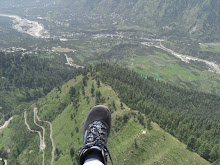
Finally, about an hour later, after I'd been sunning myself alone on the top of this cliff, the chap returned up for my go. I was hooked into the gear and then told to run towards the edge (the man was strapped to my back and he would be handling the controls). On cue, I made a mad dash: the man was shouting , "Run, run!", but it was impossible as the wind had picked up the 'chute and I was treading air, not moving. By this point I was shaking and the adrenalin had started. And before I knew it, I was in the air, floating, the Kullu Valley stretching before me, a patchwork of glorious green, the river winding through it. We flew, nothing between me and the ground, which was very far below me. As we slowly feathered down towards the ground, he asked if I wanted to do some "stunts" and before I know it we were spiralling round and round (my nose was running hard) until I was dizzy by the centrifugal force. Then he manoeuvred the paraglider so it lifted up into the air and then dropped, my stomach jumping into my mouth. It felt as if I was on a rollercoaster, except that I was hundreds of metres in the air and nothing between me and the hard earth. As we lowered I was slightly concerned by the number of electricity pylons - we seemed to be descending in a whole nest of them (it turned out the wires haven't been connected yet, so my fears were unfounded).
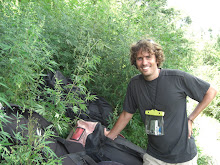
Finally we touched down. And I fell over. Ed has some of this on film, which I shall hopefully share in future. We had to carry the 'chutes to the road, which was a bit heavy. There is marijuana growing everywhere here, it lines the roads. And people do seem to spend a lot of time skinning up. This is lost on me (my poison being alcohol), and I feel terribly uncool refusing joints. But hey ho. Such is life.
Then it was a local bus back to Manali. Like everything else here, it was colourful, a bright turquoise, with interesting signs welcoming us to the "Bharti Coach". It was rammed, people lining the aisle, smiling and joking. The people here in Himachal Pradesh are very attractive: lean and lithe, with well-formed features, high cheekbones, and feline in their languidity.
Anyway, Ed wants to go paragliding again tomorrow, so I am going to see if I can get some insurance so I can go again too.
Speak soon
At the top, Ed went first. I watched with some trepidation (having signed the waiver, which was under Indian law, and excluded all liabilities including those for injury and death arising from negligence; I also mulled over the fact that dangerous sports were excluded from my insurance policy... yikes).
Finally, about an hour later, after I'd been sunning myself alone on the top of this cliff, the chap returned up for my go. I was hooked into the gear and then told to run towards the edge (the man was strapped to my back and he would be handling the controls). On cue, I made a mad dash: the man was shouting , "Run, run!", but it was impossible as the wind had picked up the 'chute and I was treading air, not moving. By this point I was shaking and the adrenalin had started. And before I knew it, I was in the air, floating, the Kullu Valley stretching before me, a patchwork of glorious green, the river winding through it. We flew, nothing between me and the ground, which was very far below me. As we slowly feathered down towards the ground, he asked if I wanted to do some "stunts" and before I know it we were spiralling round and round (my nose was running hard) until I was dizzy by the centrifugal force. Then he manoeuvred the paraglider so it lifted up into the air and then dropped, my stomach jumping into my mouth. It felt as if I was on a rollercoaster, except that I was hundreds of metres in the air and nothing between me and the hard earth. As we lowered I was slightly concerned by the number of electricity pylons - we seemed to be descending in a whole nest of them (it turned out the wires haven't been connected yet, so my fears were unfounded).
Finally we touched down. And I fell over. Ed has some of this on film, which I shall hopefully share in future. We had to carry the 'chutes to the road, which was a bit heavy. There is marijuana growing everywhere here, it lines the roads. And people do seem to spend a lot of time skinning up. This is lost on me (my poison being alcohol), and I feel terribly uncool refusing joints. But hey ho. Such is life.
Then it was a local bus back to Manali. Like everything else here, it was colourful, a bright turquoise, with interesting signs welcoming us to the "Bharti Coach". It was rammed, people lining the aisle, smiling and joking. The people here in Himachal Pradesh are very attractive: lean and lithe, with well-formed features, high cheekbones, and feline in their languidity.
Anyway, Ed wants to go paragliding again tomorrow, so I am going to see if I can get some insurance so I can go again too.
Speak soon
Subscribe to:
Posts (Atom)